Having a well-designed and functional driveway can enhance the kerb appeal of your property and make life easier for you. But with so many different driveway options available in the UK, it can be challenging to choose the one that suits your needs and budget. In this blog, we’ll discuss the different types of driveways available in the UK, the indicative costs, and their pros and cons.
Block Paving:
Block paving is a popular choice in the UK for driveways due to its versatility, durability, and its suitability for a wide range of property styles. It’s available in various colours, sizes, and patterns, making it easy to customise allowing you to create a unique look for your home. When installed professionally, a block paving driveway is a low-maintenance option and can last up to 25 years.
Indicative cost of block paving
According to Checkatrade, the cost of block paving in the UK ranges from £90 – £110 per square metre depending on the design, material, and location. The average cost for a 50m² area will set you back around £5,500. Assuming a 50m² driveway with space for a lawn.
Pros of a block paving driveway
Block paving is durable, long-lasting, versatile, and easy to repair. You can replace individual blocks if they become damaged.
Cons of a block paving driveway
Block paving is considered to be more expensive than some other driveway options. Expect to have a hefty upfront cost and is time-consuming to install. It can require regular cleaning (location dependent) and can be prone to weed growth.
Gravel Driveways:
Gravel driveways are one of the most cost-effective options for homeowners. They quick and easy to install and require minimal upkeep (just the occasional raking and topping up to maintain their appearance over time). Gravel is available in a range of colours and sizes (location dependent) so it’s easy to complement your home’s existing aesthetic. Gravel driveways are also permeable, meaning that rainwater can drain away, making them an eco-friendly choice!
Indicative cost of a gravel driveway
According to HomeownerCosts, the average cost of installing a gravel driveway is around £70 per m2 if it’s a new driveway, reduced to approx £30 per m2 for an overlay. Using the 50m2 average, you’d be looking at £3,500 or £1,500 respectively. Note that the cost will vary depending on the gravel type, installation cost, and location.
Pros of a gravel driveway
Gravel driveways are relatively inexpensive (especially when compared to other options), easy to install, easy to customise with colour and size, and provide good drainage.
Cons of a gravel driveway
Gravel driveways can be messy, can be noisy when driven or walked on and the gravel can become displaced which may require regular topping up.
Resin Bound Driveways:
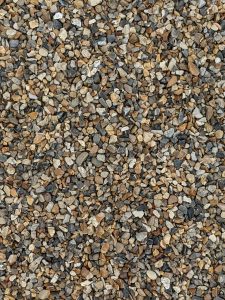
Resin-bound driveways are a modern and attractive option. They’re becoming increasingly popular in the UK due to their visual appeal and low-maintenance requirements. They’re made from a mixture of natural stones and resin which is troweled onto a prepared surface. Resin-bound comes in a range of colours and designs (location dependent) and they’re also porous which means that water can drain away quickly.
Indicative cost of a resin-bound driveway
Loftera suggests that the cost of a new resin-bound driveway will range from £40 per m2, to a high of £70 per m2. Taking the average 50m2 then, you’ll be looking at approximately £3,000 but again this will vary depending on design and location.
Pros of a resin-bound driveway
They’re visually appealing, low maintenance, long-lasting, porous, and available in a range of colours and finishes.
Cons of a resin-bound driveway
Resin-bound driveways are not the cheapest option. Generally, we would advise professional installation which will increase the cost. They can become slippery when wet and aren’t suitable for heavy vehicles.
Tarmac Driveways:
Tarmac driveways are a popular choice due to their affordability and durability. They’re also low maintenance and can last up to 20 years. Tarmac driveways are available in a range of colours and finishes and can be customised to maximise kerb appeal. They’re easy to install and weather-resistant which makes them an ideal choice for areas with heavy rainfall.
Indicative cost of a tarmac driveway
According to Smartspender a new tarmac driveway will cost anywhere between £45 m2 and £90 m2. Using our example size of a 50m2 driveway the cost will be in the region of £4,100. Worth another repeat, this is of course, dependent on location.
Pros of a tarmac driveway
Tarmac driveways are durable, long-lasting, low maintenance, weather-resistant and cost-effective.
Cons of a tarmac driveway
Tarmac generally isn’t as visually appealing as some of the other options. It can be prone to cracking and may require regular sealing. Tarmac is also prone to becoming hot during the summer months.
Concrete Driveways:
Concrete driveways are becoming a less popular choice for homeowners, but they’re still an affordable and durable option. They’re available in different colours and finishes and can be customised to make the best of your kerb appeal. Concrete driveways are also a low-maintenance option and when installed correctly can last up to 25 years.
Indicative cost of a concrete driveway
According to Household Quotes, the cost of concrete driveways in the UK ranges from £15 per m2 to £25 per m2 If you’re installing a flat concrete driveway, increased to £27 per m2 to £32 per m2 for a patterned concrete driveway. Using the 50m2 for comparison then, this will cost around £1,000 for a flat concrete drive, or £1,500 for a patterned one.
Pros of a concrete driveway
Concrete driveways are affordable, durable, and require minimal maintenance.
Cons of a concrete driveway
Concrete can be prone to cracking and can become slippery in wet conditions.
In conclusion, choosing the right type of driveway is essential for every homeowner. The different types of driveways available in the UK offer varying levels of practicality, feasibility, indicative costs, and pros and cons. Therefore, it is crucial to consider your needs, preferences, and budget before making a decision. We hope this article has provided you with valuable insights and helped you make an informed decision.
Conclusion
Choosing the right driveway for your property depends on your budget, maintenance requirements, and aesthetic preferences. Gravel driveways are cost-effective and low maintenance, block paving driveways are versatile and durable, tarmac driveways are weather-resistant and cost-effective, and resin-bound driveways are visually appealing and low maintenance.
We hope this blog has helped you to make an informed decision when choosing your dream driveway. If you need any advice or have any questions about your driveway installation in Lincoln, get in touch with us today.